



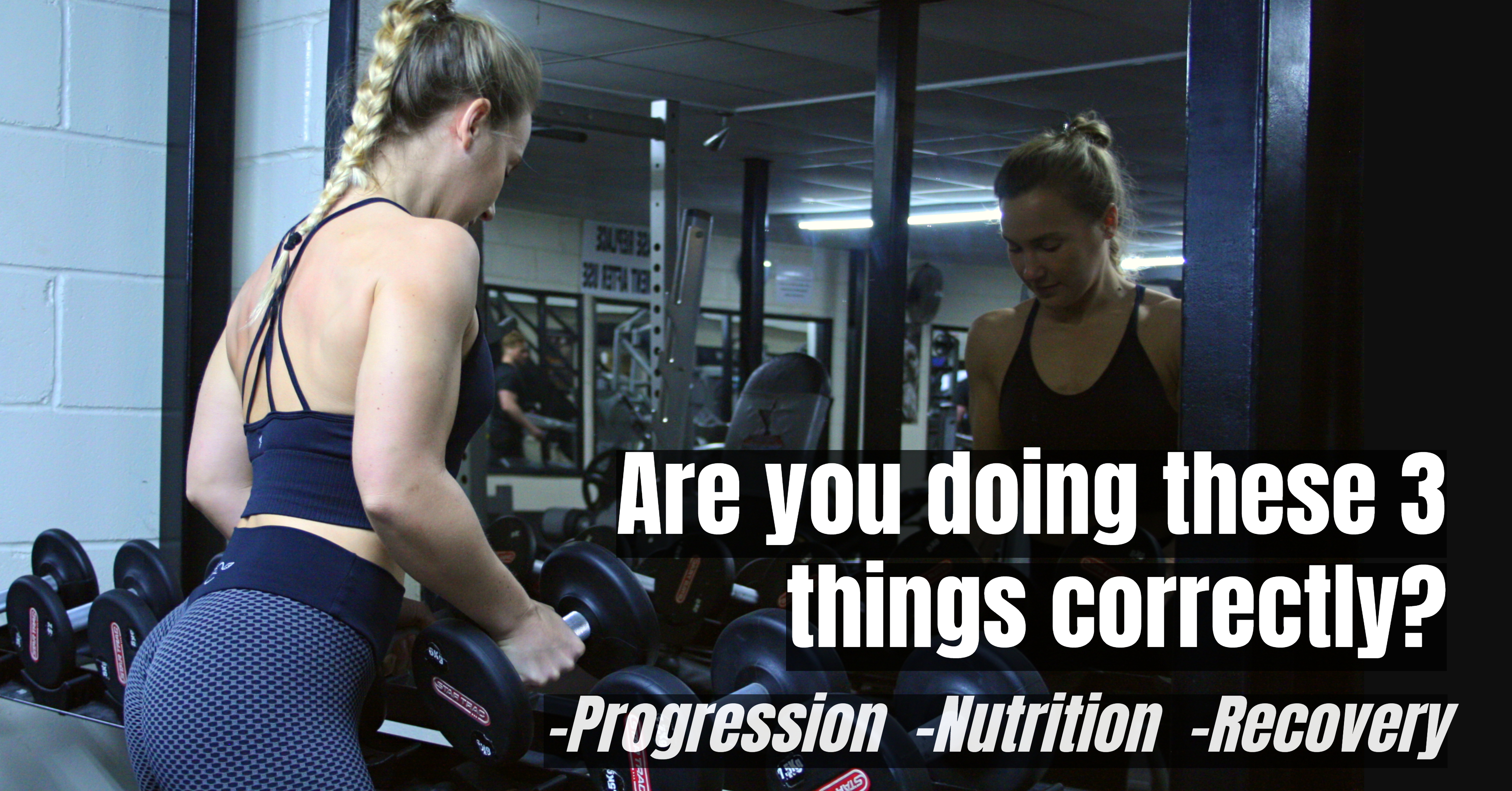
 When it comes to training, I have always educated people on 3 specific areas they must focus their success on if they want to continue to see progress in the gym. These three areas are Progression, Nutrition and Recovery.
Progression
I still find it hard to believe that people are happy going to the gym, week in week out and seeing no progress in terms of an increase in strength, muscle size or a decrease in body fat. The body is a very clever tool yet only needs simple changes to adapt. Just take a minute to answer this, do you think your body will change if you repeatedly do the same thing every week in your workout? For example, every Monday you come in and do 3 sets of 10 on bench press at 60kg. This hasn’t changed for weeks, is your body going to look any different? Of course not! The principle you need to apply here is progressive overload.
Progressive overload is increasing either the intensity, volume or frequency of a workout. The best way to apply this is by only increasing one of these in your workout though, instead of all 3 at once. Let’s take the bench press example and work with progressively overloading on the volume. Instead of doing 3 sets of 10 at 60kg, you could do 4 sets of 10. The problem here however, is that you don’t want to have to add an extra set every time you enter the gym, so how else can we do it? You either add weight, or add reps. Have a look at the table below that shows progressive overload on the bench press over several weeks.
|
Week |
Exercise |
Weight used |
Set 1 |
Set 2 |
Set 3 |
|
1 |
Bench press |
60kg |
12 |
11 |
10 |
|
2 |
Bench press |
60kg |
12 |
12 |
12 |
|
3 |
Bench press |
65kg |
9 |
9 |
8 |
|
4 |
Bench press |
65kg |
10 |
10 |
9 |
 Once you can hit the same reps for all 3 sets, the weight is increased, and you try to achieve 12 reps on all 3 sets at the new weight. This is progressive overload in its simplest form and the format can be applied to all movements. The longer you train, the slower the progression will be. The example given above is more typical to a newbie, advanced lifters may struggle to progress as fast.
One final bit of advice, you need to be aiming to progressively overload both in a calorie surplus and out of one. Just because you are shredding for summer doesn’t mean you should stop aiming to be better than your last session. If anything, forcing your body to be better will help you hold onto that hard-earned muscle.
Nutrition
You can be doing all the progressive overloading you like, without proper nutrition that matches your goals, you’ll be in no man’s land. What I mean by this Is, what is your goal? To build muscle? Get yourself in a calorie surplus. Is it to lose fat? Eat in a calorie deficit. Don’t try and build muscle and lose fat at the same time, stick to one and make it your priority. I recommend eating in a surplus of 500 calories over your maintenance for building muscle and 500 under maintenance for losing fat. For your health, you should aim for 1-2 lbs of weight gain/loss per week depending on your goal.
Recovery
 Do you know when your body builds and repairs itself the most? When you rest, not in the gym. Specifically, in your sleep. You can kiss goodbye to a lot of progress if you are getting sub 7 hours of quality sleep each night. A lack of sleep has been shown to increase the levels of cortisol in the body, which is a hormone that decreases the amount of muscle we can build and increases the rate at which fat is stored (if that doesn’t scare you nothing will). As well as getting enough quality sleep, make sure you aren’t over training. More isn’t always best in the gym. Really, if you are training hard enough, then 4-5 days a week is plenty enough. Assess yourself, if you are sore all the time, struggling to progress in your workouts, mentally foggy or have a loss of appetite, you may be over doing it. If this is the case, introduce a de-load week or use your rest days more effectively in your training program.